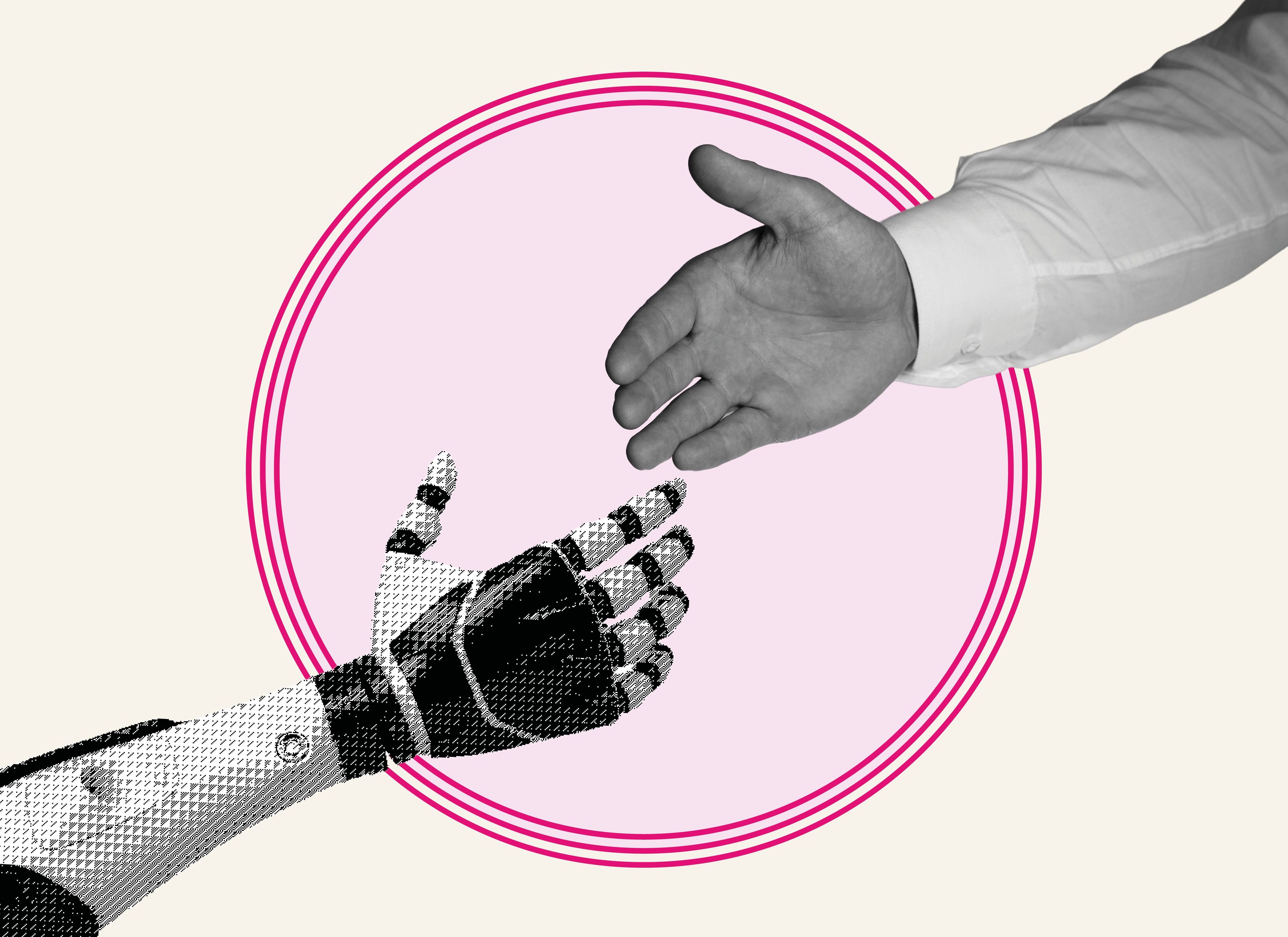
The distinction worth holding onto here lies not in their function, but in their relationship with the user. Nobody is co-piloting their toast-tanning, or letting their chainsaw trim the tree as they sit back and watch the splinters fly.
There are tools that help and tools that do, tools that take the wheel and tools that co-drive, closed systems that take full ownership of a task and force multipliers that augment our efforts. For those looking to adopt AI in any professional context, the distinction between automation and collaboration is becoming increasingly crucial.
A misguided characterisation of AI as the great replacement engine has rippled across industry since it entered the public imagination. Godfather of AI Geoffrey Hinton professed in 2016 that “people should stop training radiologists now,” giving it five years until AI displaced the profession altogether.
Respectfully, the Don got it wrong, and this prophetic error speaks to a wider fixation on automation: the belief that technology’s highest purpose is to replace, not work with us. The do-more-with-less and progress-removes-friction imperatives of the industrial boom have left us blinkered and conditioned to feel that if something can be automated, it should be.
Fast forward to 2024, and MIT researchers found that use of AI diagnostic tools, despite performing better than two-thirds of radiologists, actually caused a decline in the accuracy of diagnoses. Why? The tools weren’t built with collaboration in mind: no dialogue, no reasoning, no back and forth. Doctors were left unsure whether to trust their own judgement or to defer to the machine, accepting opaque conclusions handed down from on high over their own expertise.
Designing for complementarity requires systems that communicate and listen, thinking alongside us as a professional peer would. Take Google’s Articulate Medical Intelligence Explorer (AMIE), a system built with collaboration in mind: transparent in its reasoning, honest about uncertainty, and open to correction. In trials, doctors who used AMIE outperformed their solo counterparts in both clinical communication and diagnosis.
Approaching AI as a collaborative tool is ultimately an attitudinal shift from deference to dialogue - one that will separate expertise from dependence. In practice, it means treating and training AI systems as sounding boards to negotiate with, not to shoulder the work. There is, of course, a difference between automating a task and automating a job, if AI can provide some easy wins - pull together the research, draft the outline, or summarise the meeting - let it. But to get more out of this technology, adopters will need to do more than delegate. Train it in your industry, challenge its assumptions, and invite it to challenge yours - get conversational with it. The aim shouldn’t be to replace thinking, but to build the kind of back-and-forth that makes both sides sharper.